How to Declutter Clothes and Organize Your Closet Without Getting Overwhelmed
As an Amazon Associate, I earn from qualifying purchases.
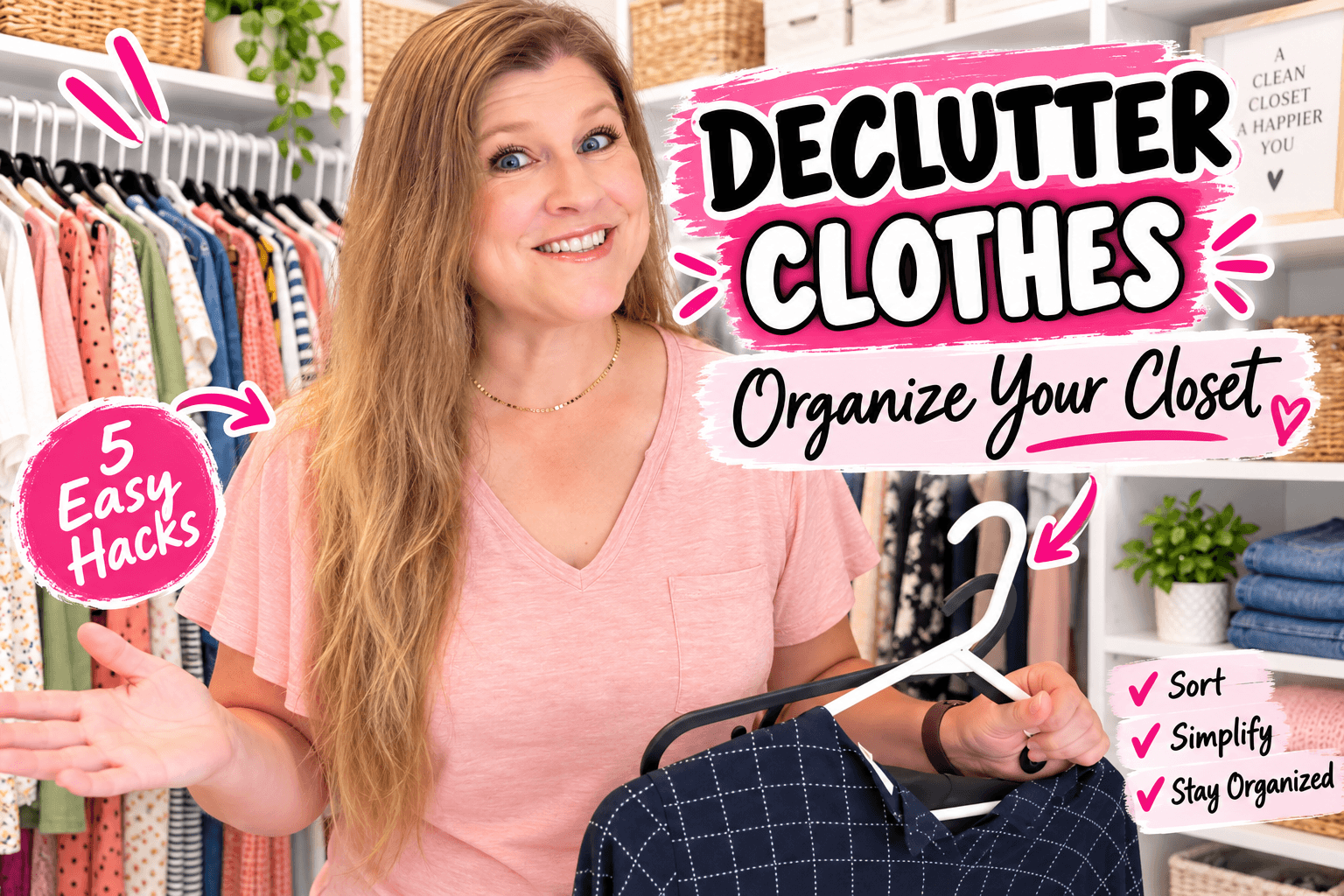
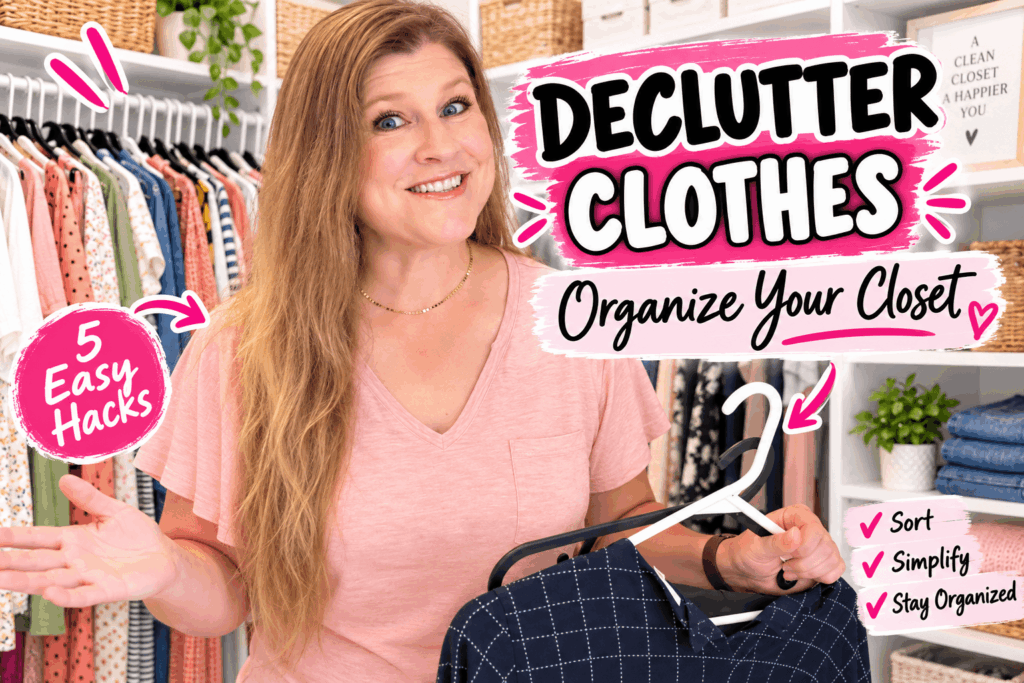
Wondering how to declutter clothes without turning your closet into a disaster zone? These five simple closet decluttering hacks can save time, cut down on decision fatigue, and make it easier to figure out what to keep and what to let go.
I don’t know a single mom who has enough hours in the day.
There’s always something that needs to get done, and decluttering a closet is exactly the kind of project that can somehow eat up an entire afternoon.
I’ve made that mistake before.
I pulled everything out of my closet thinking, Today’s the day. I’m going to completely declutter this closet.
And then about halfway through, I ran out of energy.
I was surrounded by clothes and deeply regretting every choice that had led me to that moment (If you’ve found yourself in this position, check out our 30 day decluttering challenge).
So I’ve gotten a lot more interested in little systems that make decluttering my closet easier before I even start.
If you’re trying to figure out how to declutter clothes without creating a giant mess or spending hours making decisions, these are five simple tricks that can help.
How to Declutter Clothes – Watch on YouTube

1. Let Your Closet Track What You Actually Wear
This is probably my favorite closet decluttering trick because your closet basically does some of the work for you.
Whenever I wash my clothes and put them away, I hang everything on the same side of my closet.
For me, that’s the right side because it’s right there and easy to reach.
Over time, the clothes I’m actually wearing keep cycling back onto that side.
The clothes I haven’t touched slowly end up farther and farther away.
So when I finally get around to decluttering my closet, I don’t have to stand there staring at every shirt thinking:
Do I still wear this?
If something has been sitting untouched on the far side of my closet for months, I already have my answer.
If I had been wearing it regularly, it would have made its way back over to the side where I put clean clothes away.
That makes it much easier to get rid of things without the guilt.
It’s simple, but it saves time and cuts down on a ton of unnecessary decision-making, which is honestly half the problem when you’re decluttering clothes.

2. Keep a Donation Bag in Your Closet
The next trick is ridiculously simple, but it works really well.
Keep a donation bag, box, or basket somewhere in your closet.
That way, you don’t have to wait until you have enough time and motivation for one giant closet decluttering day.
If I put something on and immediately think, Nope. I hate how this fits, I don’t need to hang it back up and reconsider my life choices three months from now.
It can go straight into the donation bag.
The same thing goes if I realize I never reach for something or I’m only keeping it because I feel guilty getting rid of it.
Then, when the bag is full, it leaves the house.
Instead of decluttering your closet becoming a three-hour project, you’re making little ten-second decisions along the way.
Recommended Products
These clear, stackable bins are great for both “maybe” clothes and donation piles. Use one for clothes you are not quite ready to get rid of yet, then give yourself a deadline to decide whether they stay or go. You can also keep a separate bin for donations so clothes have somewhere to go the moment you decide you are done with them, instead of ending up back in the closet.

3. Give Your “Maybe” Clothes a Deadline
We all have those maybe clothes.
Not everything in your closet is an easy yes or no.
There are always clothes where you think, I might wear this again.
And maybe you will.
So instead of standing there debating one shirt for ten minutes, put those pieces in a separate bin, bag, or even a dedicated section of your closet if you have enough space.
Then give them a deadline.
Maybe it’s three months.
Maybe it’s six months.
If you haven’t gone looking for anything in that section by the time the deadline rolls around, that tells you a lot.
I like this method because you aren’t forcing yourself to get rid of something before you’re ready.
You’re just taking it out of your everyday closet space and letting time help make the decision for you.
Recommended Products
These clear, stackable bins are great for both “maybe” clothes and donation piles. Use one for clothes you are not quite ready to get rid of yet, then give yourself a deadline to decide whether they stay or go. You can also keep a separate bin for donations so clothes have somewhere to go the moment you decide you are done with them, instead of ending up back in the closet.
4. Stop Dressing Your Imaginary Future Self
This one can be a little painful.
Sometimes we keep clothes for a version of ourselves that doesn’t actually exist.
Maybe it’s a dress you keep thinking you’re going to wear when you suddenly start going to fancy events every weekend.
Maybe it’s uncomfortable shoes that are really cute, but somehow every time you leave the house, you choose literally anything else.
Maybe it’s clothes from a job you don’t have anymore.
Or maybe it’s something you hope you’re going to fit into again someday if only ice cream would stop tasting so good.
That may be a “me” problem.
If something only works for a life you don’t actually live, it probably doesn’t need prime real estate in your closet.
Your closet should work for the life you have now, not some imaginary version of you who apparently has completely different plans, hobbies, and tolerance for uncomfortable shoes.
If you genuinely think you might use something later, pack it away and give it a deadline.
If you still haven’t used it by then, move it into the maybe category and reconsider whether it really needs to stay.
5. Ask Yourself, “Would I Buy This Again?”
This is one of the fastest ways I know to get out of the but it’s still perfectly good mindset.
I’m really bad at hanging on to things that still have a lot of use left in them, even when I don’t actually use them.
So instead of asking:
Is there technically anything wrong with this?
Ask:
- If I saw this in a store today, would I spend money on it again?
- Would you buy it in this size?
- Would you buy it in this color?
- Would you buy it knowing exactly how it fits?
- Would you buy it knowing how often you actually wear it?
If the answer is no, that makes the decision a whole lot easier.
Sometimes we aren’t keeping something because we love it.
We’re keeping it because we already paid for it or because it feels uncomfortable to get rid of something that is still usable.
Unfortunately, storing it in your closet for another five years is not going to refund your money or make getting rid of it any easier.
How to Declutter Your Closet Without Making It a Huge Project
The biggest thing for me is making decluttering less of an event.
I don’t want to block out half a Saturday every time my closet gets out of control.
The more little systems you can build into things you’re already doing, the easier it gets.
Let your closet track what you wear.
Keep a donation bag nearby.
Give the maybe clothes a deadline.
Stop saving half your closet for an imaginary future version of yourself.
And ask whether you would actually buy something again today.
None of these things are complicated, but together they can save a ton of time and a lot of unnecessary decision-making.
And honestly, I think the decision-making is half the reason decluttering is exhausting in the first place.
There are enough decisions we have to make every day.
Nobody needs another hundred of them coming from their closet.
What to Do With Clothes After You Declutter Them
Getting clothes out of your closet is only half the battle. The other half is making sure those bags and boxes do not sit in the corner of your bedroom for the next six months.
I have absolutely been guilty of creating a perfectly organized donation pile and then leaving it there long enough that it basically becomes part of the furniture.
So once you decide something is leaving your closet, it helps to have a plan for where it is actually going.
Donate Clothes That Are Still in Good Condition
If something is clean, wearable, and in good condition, donating it is usually the easiest option.
You can donate clothes to thrift stores, local charities, shelters, community organizations, or clothing closets. Some schools and churches also collect clothing for families in need.
The key is to make donating as easy as possible.
If you already know where you plan to donate, label the bag when you start filling it. Then, once it is full, put it straight into your car so it is one step closer to actually leaving your house.
Otherwise, there is a very real chance that bag is going to live in your closet for another three months.
Sell Clothes That Are Worth the Effort
There are some clothes that may be worth selling, especially if they are newer, from a popular brand, or still in excellent condition.
But this is where I think it is important to be realistic.
Selling clothes takes time.
You have to photograph them, list them, answer questions, package them, and sometimes deal with people who want to offer you $3 for something you paid $80 for.
So before you create a giant “sell” pile, ask yourself whether you actually have the time and energy to follow through.
One thing that can help is setting a deadline.
Give yourself two weeks or a month to list the clothes you want to sell. If you have not done it by then, move them to the donation pile.
The goal is to get your space back, not create another project.
Give Clothes Away to Someone You Know
Sometimes the easiest option is simply asking someone you know if they want something.
This works especially well for kids’ clothes, coats, specialty clothing, or items you know a friend or family member might use.
You can also use local Buy Nothing groups or neighborhood groups to give clothes away.
Just be careful not to turn this into another storage situation where you are keeping bags around because someone might want them someday.
Set a deadline and move on if nobody claims them.
Recycle Clothes That Cannot Be Donated
Not everything belongs in a donation bin.
If clothing is badly stained, ripped, stretched out, or worn beyond use, donating it can just pass the disposal problem on to someone else.
For clothes that are no longer wearable, look for textile recycling programs in your area.
Some retailers and community recycling programs accept old clothing and fabric, even when the items are not in good enough condition to wear.
You can also repurpose some old T-shirts or towels into cleaning rags if you will actually use them.
The important part is being honest about whether you are really going to repurpose something or whether you are just finding a new reason to keep it.
If you have clothes that are too worn out to donate, the EPA recommends checking with local charities and retailers to see whether they accept damaged clothing or shoes for textile recycling.
Set a Deadline for Anything Leaving Your Closet
This may be the most important part.
Once you decide something is leaving your closet, give it a deadline to leave your house too.
That might mean donations go into your car on Friday.
Items you want to sell get listed within two weeks.
“Maybe” clothes get three months.
The exact timeline does not matter nearly as much as having one.
Otherwise, decluttering can turn into moving piles of stuff from one room to another, which is not exactly the goal.
How Often Should You Declutter Your Closet?
You do not need to do a giant closet cleanout every month.
In fact, if you use some of these little systems throughout the year, you may never need to do another massive all-day decluttering session.
I like the idea of doing a quick closet check a few times a year, especially when the seasons change.
Look at what you actually wore.
Look at what you skipped over all season.
Check your donation bin.
Check your maybe clothes.
See whether there are things taking up space that no longer make sense for your life.
Even 15 or 20 minutes can make a big difference if you are keeping up with it along the way.
The goal is not to have a perfectly minimal closet.
The goal is to have a closet that works for you and does not create more work than it needs to.
That is really the whole idea behind these hacks. Decluttering should make your life easier, not become another exhausting project on your to-do list.